

Brawn - Brand - Bullshit... Pick two.
You cannot policy your way into a global race. We have the brawn, sell the brand, time to sort the .... Optimise for two, drive convergence.

By Dr. Mayank ‘Rocky’ Verma CEO, Kaipability Ltd
A response to: “The Labour Party Is Playing With Fire Over Its Future and the Future of the Country” by Tony Blair, 26 May 2026
What would you like to do when you grow up?
Chose Aerospace Engineering to get into F1. From watching every race, at every godforsaken hour. By the time I got to the MEng bit, I’d psychologically dropped out. Not one thing. Never is.
Ecclestone’s vendetta against Ferrari. Nine-day CFD runs to failure. No GPUs, blue screens of death. Plugs pulled by a cleaner’s energy-saving policy. FFS. Patience required.
“Don’t turn off this PC, Simulation Converging!!”
Somewhere in those years UMIST had turned me into a Manufacturing Engineer and a Mancunian. You don’t notice that at 22. You notice it at 42. Makerville, or meet your maker.
The race is the show. The factory is the power. Everyone watches the grid; almost no one watches the people that build it.
The future was never on the track. It was on the line that made it possible.
Only To Be Told, I Can’t See, I Can’t Breathe
Britain is brilliant at the easy half of innovation and quietly stopped doing the hard half. Talk is easy. Building at scale, when it matters, is not. We polished the talking to a mirror shine and let the building rust. Now here arrives LLMs.
A former Prime Minister has just written nine thousand words agreeing the government totters with every breeze. Correct diagnosis. Then the same reflex: alliances, markets, position, regulation. The four levers a clever man pulls when he has never stood on a shop floor.
He wants ballast and reaches for a better navigator. Nobody is asking who will drive.
The whole debate is really about brand, and nobody will say it. Britain has one: the best engineering reputation in the world, won over two centuries. Blair’s entire essay, and the Tony Blair Institute, is brand management. Position, a seat at the table, being seen to matter. Don’t mention the WMDs, become them. The reflex of a country that thinks its reputation is the asset. It isn’t. The asset was always the capability under the reputation, and capability eats brand for breakfast.
Two days ago Ferrari unveiled its first electric car, a glass-wrapped thing by Jony Ive’s studio. The market wiped five billion dollars off the company in a day, and a former chairman said they should take the horse off the car to avoid destroying the myth. Brand floated free of the thing that earned it. The badge survives; the capability it stood for does not. But a new kind is emerging, and no PR team or design studio can fake it.
Brand without capability is a cheque the factory can no longer cash.
There is No Sound, For We All Live Underground
In the early 2000s Schumacher and Ferrari became, in the words of the man who built it, an infernal machine. Ross Brawn OBE (Not a Sir!), commercial and technical director (Machinist) and one of the finest Manufacturing Engineers the sport ever produced, admits the juggernaut would not have stopped any other way. Schumacher won 13 of 18 races in 2004; five straight titles, 2000 to 2004. The dominance broke the season I graduated.
Watch how a sport kills itself trying to stay exciting.
I will admit it bored me also. Win after win, the result known by lap two. But that was never his fault: not too much excellence, too little competition for it. The sport’s answer was not to find a better rival. It was to handicap the one they had: banned mid-race tyre changes, rewrote qualifying to throw fast cars out of position. The gimmick era. Rule after rule, each designed to slow the thing that was too good.
They could not beat the best machine on the track, so they legislated against it. The man who built it agrees.
It is the whole of Western “Industrial policy” in one sentence. When a system cannot tolerate excellence, it regulates it away and calls the result fairness. The honest fix was never to slow the leader. It was to build a challenger worth watching.
That is one way a country loses its edge. The other is quieter: it stops building and starts pulling in “Innovation Managers”, holding panels and meetings about building. Calls it policy. Reports pack out the paddock.
Things That Are Big That Should Be Small
People assume policy is hard. It isn’t. It’s usually just empty.
An example. A four-billion-dollar global “Industrial Titan”, 2020, additive manufacturing at peak hype. I made a rule (ahem, policy): every site keeps at least one 3D printer by year end. Buy anything that fits the constraints, the shopfloor and the budget. No PowerPoint, no business-case theatre, just put the machine in the building. They all became magnets of progress. Some created millions in proven value, some didn’t; some sites now run multiple continuously. Meanwhile the institutions were still writing strategy decks about Additive Manufacturing changing the world and showing off stranded prototypes… Let’s not go there today.
That is what policy is. A deployed action with a measured result. Everything else is talk with no customer.
Now look at what Britain calls policy instead. Between the research and the real world sits a layer: knowledge-exchange professionals, trade bodies, transformation consultants, convening bodies. Call it the apparatus. It costs £5 to £8 billion a year, and its one job is to turn research into things that exist. At the going rate of return, it would have to be the sole reason twelve to twenty billion pounds of research reaches the real world each year instead of leaking abroad.
A fifth of the research base, on its back. Twenty years of identical reports say it isn’t.
For Useless Twisting of Our New Technology
Below that bar, the apparatus isn’t converting the research. It’s sitting in the spreadsheet between the spend and the result, taking the credit and dragging the number down.
And here is the part that should make you put the coffee down. We pay the people who run this layer like FTSE 100 “Chief Executives”. Danger money, for a job with no danger in it. The board that should hold them to account is drawn from the same pool, marking its own homework.
So we tell ourselves the £8 billion is working, when what we bought is £8 billion of very well-produced entertainment. The bill comes due anyway, mid-corner, in the wet.
We pay them like they run Airbus and protect them like they run a book club.
I’m Thinkin’ What a Mess We’re In, Hard to Know Where to Begin
The engine is excellent. The brakes are good. The telemetry says the driver is shite.
But an engine needs fuel as well as a driver, and brawn at the scale that matters, fabs, energy, factories, is built with staggering capital. The Modern Industrialist is not the engineer who disdains the money. It is the one who can make the thing and marshal the billions. We have split those two people apart, and neither half wins the race alone.
None of this is because the raw material is poor. The opposite, and that is what makes the waste criminal. Britain spends around £72 billion a year on R&D. Fully applied, that base should throw off some £29 billion a year in social value.
And here is the thing Blair won’t name.
The superior future is being built right now, and not here. Machine-driven, electric, relentless, a little sterile. People may not love it. It wins anyway, because the stopwatch does not care what you find romantic. It cares about winning. The G2/3 are pouring its foundations while Britain debates its reputation.
You only get to decide whether you build it or buy it.
The harder truth, no five-year politician has the incentive to say: sometimes the old thing must die for the green shoots to come. The services-and-finance settlement may need to end, cleanly, before the next can root.
A nation that cannot let its dead industries and institutions die, will never have soil for the living ones.
Nothing’s Gonna Change the Way We Live
Watch what happens to a system tuned for performance with nothing held in reserve. It looks strong until it starts pissing it down.
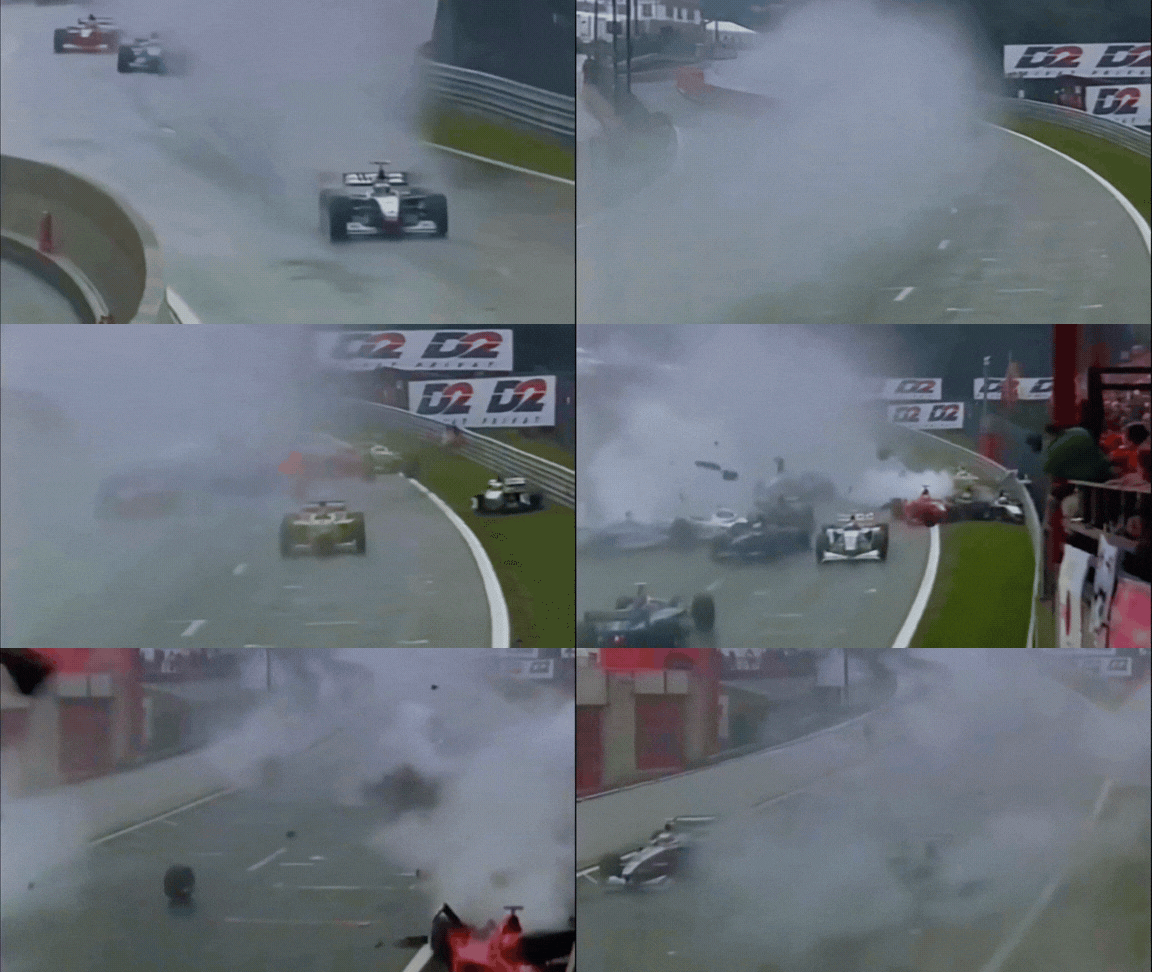
Spa, 30 August 1998. Torrential rain. At the start, David Coulthard’s McLaren ran over a drain cover, speared into the wall, and bounced back into the pack. In fifteen seconds, thirteen of twenty-two cars were gone, the most ever wrecked in the shortest time in the sport’s history. One node hits a drain cover in the wet and takes half the grid with it.
But out of that carnage one team came through and won. Jordan, yellow and black, nobody’s favourite, took its first ever Grand Prix victory in the wet, the day half the grid ended in the wall.
Sometimes it isn’t just the machine. Sometimes it’s the driver… and luck.
So we wait for a miracle? A unicorn, a moonshot lab, a strategy with a glossy cover. Will before skill? Or skill with will. Ross will tell you what wins in the real world and dots don’t connect themselves.
It was never a miracle we needed. It was a “factory”. Brits can start carnage and also cunningly win whilst the rest crash themselves out of the race.
It has always been wacky races.
There’s Nothin’ So Bad as a Man-Made Man
Would you rather a car too heavy to win, or one that delaminates on impact?
There is always a third option, the oldest move in the shop. You fold. Not fold as in quit, the way a country that forgot it makes things hears the word. Fold as in the press: flat sheet in, force down a chosen line, metal out bearing load it could not before. F1 folds carbon now, not steel. Plies laid by hand, cured under pressure, load carried where you put it.
Get the layup wrong. It delaminates. Holds its shape, looks perfect, then lets go in that 180mph corner, and you feel it before the telemetry does. The wet-brown patch…that comes before impact.
The fold is the decision. The delamination is what you get when nobody made it.
And not just metal. Nor composites. Moore’s Law hit the wall this year: the transistor cannot shrink further, so the most advanced manufacturing on earth does the only thing left. It stacks, packages, folds the chip into the third dimension. The frontier of silicon and the oldest move in the press shop are the same. Own the press.
The next driver is not a personality. It is a mindset this country produced in vast quantity and then forgot what they were called. Manufacturing Engineers.
Fast, good, cheap: pick two. Brawn, brand, bullshit: same trap, except only one wins races.
Futures Made of Virtual Realities
So which team on the grid is Britain?
Not Ferrari, all brand. Not the budget-backed front-runners, where performance is a function of spend in a sport that long ago became luxury entertainment with a cost cap.
Britain is Williams? The independent that won nine titles on engineering nous, got hollowed out, sold its name to a holding company while the engineering became a subsidiary, and now has an ex-Brawn man with a plan: clawed back to fifth last season, then slipped to eighth this one, having turned up with a car too heavy to win. The Catapults were our version of the recovery plan. Fifteen years on. Some overweight. Some never fit to race. A lot of PR with no production…of anything.
The glitter has gone. The disqualification flag is waving.
The question was never whether the talent exists. It is whether the plan survives contact with the next overweight car. Or whether someone finally builds one light enough to win.
Poor start, dropped to fifth, missed the carnage, won. Sometimes the bad grid slot is the one that survives. Or back to the back?
By the way, yes I did make it into F1 after my degree (briefly): calibrating the multi-axis machine tools for McLaren, Mercedes, Red Bull, where a few microns decide who sprays the champagne…
What do you want to be when you grow up?
Why This Stops Here
There is a “How.” It is not in this document, and the most advanced AI on the planet will not generate it for you either.
The “How” lives in people. Specific people, with specific knowledge of how things are actually made. They are mostly absent from the rooms where strategy gets written, which is exactly why the strategy keeps getting rewritten while the oil leaks out the back.
When the world’s tracks turn to mud, you want experienced drivers with instincts, scars and credibility, not advice from the pit-wall. Find them. Build them new vehicles. AI augment them. A new global race is here. Time to own the opportunity while it’s still damp.
If you work in advanced manufacturing, industrial strategy, defence-industrial capacity, or the production end of the AI build-out, and you want the full analysis, including what in your own organisation is actually load-bearing, get in touch. Looking to build the new crew.
mrv@kaipability.com | bookings.kaipability.com
Happy to share context and discuss.
About This Document
This article is part of an ongoing digital twin experiment, capturing reasoning patterns developed over twenty years in advanced manufacturing, so they’re not lost when the people who hold them retire.
The argument here is that the country still has people who could say it and mean it, and a system that no longer knows how to put them in the room.
AI without human calibration produces fluent nonsense. Human analysis without AI augmentation leaves patterns unnoticed. This is what collaboration looks like when both sides bring their full capability.
- Rocky Verma, May 2026
Notes
Notes, glossary and sources below. This stuff is for people who want context…
Intent: Written constructively, for own reflection and learning. This is a response to Tony Blair’s essay, not an attack on the man. We agree and disagree. The argument is not that any individual is a villain. It is that the British system rewards position over production, regulates excellence rather than building more of it, mistakes brand for brawn, and is running out of time to flip from incremental to radical. The fix is a change in who holds the wheel: the people who can actually make things, in the room, building and delivering policy rather than being consulted after it.
Key Terms:
Brawn (the capability): the accumulated ability to actually make the thing, to microns, repeatably, at volume. It takes decades to build, generations even, because it lives in people and tooling and tacit know-how that cannot be bought off a shelf or stood up in a parliament. It can be destroyed in a single budget cycle: close the plant, lose the team, break the chain, and the brawn is gone in a way no amount of money quickly rebuilds. The title’s first B, and the one the other two are worthless without.
Brawn, Ross (the man, the “Manufacturing Engineer”, not a Sir!): the patron saint of the first B, and the proof that the archetype is real. No engineering degree, came up through the machinist apprenticeship and machine tools, Mancunian to shopfloor apprentice to mastermind of 16 World Championships. The living argument for makers in the room, and the kind of CV today’s credential filters would never let near it, blind to a class of cognitive ability they cannot measure. Ask yourself, why isn’t he chairing ARIA?
Brand: the reputation that sits on top of the brawn, a promise about what the capability can do. Decades to earn, but it dies faster than brawn, in an afternoon, because it is the thinner layer and the more easily hijacked. Destroyed three ways today: handed to a design studio that mistakes the badge for the substance (the Jony Ive Ferrari); a famous capability consumed on one-off prototypes (McLaren on a single MoD car, brawn pointed at the wrong target); or by association, tying your standing to a partner whose own brand is falling (Britain hitching to a fading US). Brand without brawn is a cheque the factory can no longer cash.
Bullshit: the title’s third B, and the cheapest of the three to produce. Where brawn is capability and brand is earned reputation, bullshit is the activity that mimics both while creating neither: the strategy deck, the convening body, the policy-as-lobbying, the £8 billion of very well-produced entertainment. It is seductive precisely because it is fast and safe, the opposite of brawn, which is slow and exposed. A country under pressure drifts toward bullshit because it pays the same salaries with none of the risk. The whole argument of this piece is that you cannot policy, position or PR your way into a global race. Only brawn wins, and the other two only matter if the brawn still exists.
The Iron Triangle (pick two): every Manufacturing Engineer knows the rule, fast, good, cheap, pick two: you cannot have all three, and the one you pretend to keep is the one you are lying about. A real triangle has three corners you choose between. These three do not behave: Brawn is the only one you build, Brand sits on top of it, and Bullshit is not a corner you pick at all. It is what floods the space where Brawn used to be.
Modern Industrialist: the variant Britain has not built yet. Not the Old Industrialist (Bessemer, capital and capability fused), not the Capitalist (money without making), not the TechBro (narrative without atoms), but someone who owns the How, can marshal the billions deep-tech brawn actually costs, and sits in the room to write and deliver policy rather than be consulted after it. Good policy comes from the gut of someone who has built things; Britain's deeper failure is that it no longer trusts that gut, despite Brawn showing exactly why it should. The driver this piece keeps asking for is this person.
TBI (Tony Blair Institute): Blair’s think tank and advisory operation. Cited here as the institutional form of brand management: position, convening and influence as the product, the reflex of treating reputation as the asset rather than the capability underneath it.
WMD: in the body, “don’t mention the WMDs, become them.” The phrase that sank a previous Prime Minister’s brand (Iraq, Weapons of Mass Destruction) now has a second sense in the Trump era, Weapons of Mass Distraction: the post that moves a market before lunch. Both are brand-by-association risks for a Britain hitching its standing to a partner whose own brand is falling. Same three letters, two ways to detonate a reputation.
Manufacturing Engineers, verbs on verbs: Manufacture is a verb. Engineer is a verb. The discipline is doing, compounded, making things that make things, not a noun you park on an org chart. What people do not yet realise is the span one proper ME holds in a single head: R&D, operations, engineering, IP, finance, HR, IT and OT, integrated, not coordinated across a committee. That is the unit being lost. A country that treats manufacturing as a sector to be managed, rather than a verb to be practised, loses the ability to do it. If you spot misuse of the term, Red Flag it.
MEng (Hons): a four-year integrated master’s in engineering, the fourth year being the master’s-level capstone beyond the three-year bachelor’s. The author’s was Aerospace Engineering at UMIST.
UMIST: the University of Manchester Institute of Science and Technology, a powerhouse of British engineering education, merged into the University of Manchester in 2004. The author’s alma mater, and where an aerospace degree quietly became a manufacturing-engineering training without anyone calling it that.
CFD (Computational Fluid Dynamics): simulating how fluid flows around an object by solving the governing equations across a mesh of millions of cells, iterated until the numbers stop changing (”converging”). On year-2000 hardware, a single 3D run meant seven to ten days of continuous compute. If you don't get a blue screen of death in those 10 days. The author ran one of the first such 3D simulations modelling an F1 wheel for a third-year project (85%, marked by Prof. Antonino Filippone). That wheel is now swapped out in a 1.80-second changeover: four parallel operations, synchronised, zero defects. Britain has got world-class at the two-second changeover also.
GPU: graphics processing unit, the parallel-compute hardware that has collapsed CFD solve times. The author’s wheel took nine days on a single-core desktop PC; the same class of 3D flow solve now runs in hours, not days. Fluent (now Ansys, GPU-native since 2023) reports a 45-million-cell compressor that took a week on CPUs completing in about three hours on a single GPU, and a 2.2-billion-cell run cut from 38.5 hours to 1.5 on a thousand-plus GPUs. The “hero” calculation that once meant weeks is now a coffee break. Which sharpens the point: the compute got nine-days-to-hours cheaper, and Britain still let well intentioned people pull the plug, metaphorically, on the capability the compute was meant to serve.
F1 / MoD: Formula 1; the Ministry of Defence.
MTT (Machine Tool Technologies Ltd): the author’s first employer out of university. MTT got into elite production environments, McLaren, Mercedes and Red Bull among them, by redefining machine-tool maintenance as a precision discipline and teaching Toyota Lean-TPM at the same time. Moonshot to money. The capability earned the room. It is the bee-becoming-flower move, lived, twenty years before this piece named it.
Lean-TPM: Lean manufacturing combined with Total Productive Maintenance, the Toyota-rooted discipline of keeping equipment in peak condition as a production strategy rather than a repair function. Teaching it to Toyota is the detail that signals MTT was operating at the frontier, not following it.
Capability vs prototype: a prototype is one working object; capability is the ability to make the ten-thousandth one, at falling cost, on a line still standing under demand. Defence-industrial mass is capability, not prototypes. McLaren’s 1.80-second pit stop is capability. McLaren’s one MoD car is a prototype.
The £29bn, and why it’s honest: UK R&D spend is ~£72bn/yr. The social rate of return on R&D runs around 40% (roughly double the private return; the Treasury’s hurdle for public investment is 3.5%), so full application implies ~£29bn/yr in social value. But 40% is an average across existing research, not a prediction for any single pound, and £29bn is potential return. What Britain actually captures at home is lower, precisely because of the deployment failure, and that realised figure is the one number nobody can measure cleanly. We can size the inputs to the pound; we cannot size what leaks out the back. That gap is not a flaw in the argument. It is the argument.
The break-even bar: for the ~£5–8bn apparatus to justify itself at a 40% return, it must be solely responsible for deploying ~£12.5–20bn of research output a year that would otherwise leak, the reason 17–28% of the entire national research base reaches application. An attribution test, not a measured outcome; twenty years of unchanged diagnoses suggest it isn’t cleared.
Kaizen / Kaikaku: Japanese manufacturing terms. Kaizen is continuous incremental improvement; kaikaku is radical step-change. Britain is stuck doing kaizen at the wall, polishing the part that no longer decides anything, and avoiding the kaikaku flip. The arc on the Kaipability mark is exactly this: patient improvement that, at its limit, must break into a step.
Moore’s Law (and the fold into 3D): the sixty-year observation that transistor density roughly doubled every couple of years by shrinking the transistor. As of early 2026 that geometric shrinking has hit a physical and economic wall: you cannot usefully make the transistor smaller. The industry’s response is to stop going smaller and start stacking, chiplets, 3D die-stacking, hybrid bonding, advanced packaging, so the metric becomes transistors per package rather than per chip. It is, almost exactly, the press-shop fold: when the flat plane is exhausted, you fold into the third dimension to bear the load. The frontier of semiconductor manufacturing and the oldest move in metal forming converge on the same idea.
Bee vs flower: a strategy metaphor. The bee chases (transactional, dependent, always moving). The flower builds something so valuable the bees come to it: capability as the held asset. (The yellow-and-black Jordan that won Spa 1998 in the wet, on the day half the grid crashed out, is the wink: bee colours, but the survivor, the drive that came through the flood. Sometimes you need luck. But you make your own luck.)
Two tracks (and the monsoon): a healthy industrial economy runs a thin world-class layer and a broad living base that feeds it. Britain’s base hollowed out over decades (the Catapult network was the 2010s attempt to rebuild the bridge between them), leaving the top layer increasingly unsupported. The “monsoon” is the argument’s turn: as the Economist’s 2026 piece on the “industrial rot” of Japan, Korea and Taiwan shows, the hollowing is now global, AI revenue masking a China shock beneath. When every track floods, advantage shifts from brand and slickness to operators who have run in the wet, experienced industrial capability, before.
R&D / GERD / G2/3: R&D is research and development; GERD is Gross Expenditure on R&D, the national total across business, government and academia (~£72bn/yr). G2/3 is the shorthand (Blair’s) for a world order in which superpower status is shared by the US and China, India joining in time, leaving every other nation a middle power.
Sources:
Lizard brain from/for the “Virtual Insanity” by Jamiroquai (Jay Kay / Toby Smith), from Travelling Without Moving, 1996 (remastered). Used as structural homage, not reproduced as full verse. He was ahead of his time. No coincidence logo emulates Ferrari’s. Wonder what he makes of their new EV?
Tony Blair, "The Labour Party Is Playing With Fire...", 26 May 2026 (the piece responded to).
Schumacher/Ferrari dominance, 2005 tyre-change ban, the "gimmick era"; Brawn's "infernal machine" / "would not have stopped any other way" (F1.com, Brawn interviews, PlanetF1, Bleacher Report).
Ross Brawn's record: Appointed OBE in the 2010 New Year Honours for services to motorsport (Brawn GP's double title, 2009); never knighted. Harwell apprentice 1971, milling machinist at Williams 1978, TD at title-winning Benetton and Ferrari, owner of Brawn GP. (Wikipedia, F1.com).
Williams F1: nine Constructors' titles 1980–1997, no win since 2012; bought by Dorilton 2020 (~$180–200m); trades under licence to Williams IP Holdings LLC with Williams Grand Prix Engineering Ltd the registered company; James Vowles (ex-Brawn/Mercedes) principal from 2023; fifth in 2025, eighth in 2026, ~28kg overweight. Cost cap from 2021, $145m (Sportico, PlanetF1, Motorsport, F1.com, company filings).
1998 Belgian GP: 13 of 22 out in the first-corner pile-up; Coulthard the trigger; Hill won Jordan's first GP in the wet (Formula1.com, Autosport, Motorsport.com).
F1 pit-stop record 1.80s, McLaren, 2023 Qatar GP (motorsport reporting).
Ferrari Luce: first electric Ferrari, Jony Ive / LoveFrom, ~$5bn single-day fall (~8%), Montezemolo's "take the horse off that car" (CNBC, TechSpot, GrandPrix.com, Proactive Investors, 25–28 May 2026).
Moore's Law at the wall: shrinking hit physical/economic limits by early 2026, advanced packaging now the primary performance lever (semiconductor-industry analysis, 2026).
Economist, "industrial rot" in Japan, South Korea, Taiwan: AI revenue masking a China shock, 27 May 2026.
UK R&D: GERD ~£72bn/yr; social return ~40%, private ~20%, Treasury hurdle 3.5% (Frontier Economics; 2024 DSIT study, Bank of England peer-reviewed).
McLaren/MoD single-vehicle project (innovation-sector webinar, May 2026; primary observation).
GPU CFD timings: Ansys Fluent benchmarks 2024–2026 (45M-cell ~1wk CPU to ~3hr on one A100; 2.2bn-cell 38.5h to 1.5h on 1,024 MI250X, Baker Hughes/Oak Ridge).
Further reading:
“It’s a Supermarket Sweep”: the $104tn opportunity is an Advanced Manufacturing one, not a “Physical AI” one; the Manufacturing Engineer as both customer and builder, and the demolition of the institutions that produced them. kaipability.substack.com/p/its-a-supermarket-sweep
“Manufacturing Fetishism: All Pleasure, No Production”: response to the FT’s Apple-at-50 piece; everyone admiring manufacturing, no one doing it; heavy assets, low obsolescence. kaipability.substack.com/p/manufacturing-fetishism-all-pleasure
Fact-Check:
"Ross Brawn OBE, not Sir; machinist apprenticeship, no degree": verified. OBE in the 2010 New Year Honours for services to motorsport (Brawn GP's 2009 double title); never knighted. Mechanical craft apprentice at the UK Atomic Energy Authority, Harwell, from 1971; milling machinist at Williams from 1978; technical director at title-winning Benetton and Ferrari; owner of Brawn GP. Born Ashton-under-Lyne. "16 World Championships" is the author's combined count of constructors' and drivers' titles across teams where Brawn was essential. The "credential filters / class of cognitive ability" line is the author's editorial reading
Schumacher won 13 of 18 races in 2004; five straight titles 2000–04”: verified. The dominance broke in 2005, the year the author graduated.
“The man who built it agrees” (Brawn on regulating Ferrari away): verified; the “infernal machine” and “would not have stopped any other way” are Brawn’s own framing, not invented.
“13 of 22 cars gone in fifteen seconds, the most ever wrecked in the shortest time” (Spa 1998): verified. “Jordan came through and won”: verified (Hill, Jordan’s first win, in the wet). The drive-matters reading is the author’s, drawn from a real result.
“1.80 seconds, improved by twelve hundredths in a decade”: verified.
“$5bn off Ferrari in a day” / Jony Ive / “take the horse off the car”: verified against contemporaneous reporting (shares off ~8%; Montezemolo quotes confirmed). The brand-vs-capability reading is the author’s interpretation, not a claim about Ferrari’s engineering.
“Moore’s Law hit the wall this year; the industry folds into 3D”: verified directionally: shrinking has hit physical/economic limits and advanced packaging is now the primary performance lever. The metalworking-fold parallel is the author’s.
“Britain is Williams”: verified. Nine Constructors’ titles 1980–1997, sold to Dorilton in 2020, brand and engineering now split into separate legal entities, Vowles (ex-Brawn) leading the recovery, fifth in 2025 to eighth in 2026 with an overweight car, all confirmed against contemporaneous reporting and Williams’ own filings. The “ex-Brawn man with a plan” is literal: Vowles strategised at Brawn GP before Mercedes. The team-as-nation reading, and “we are still overweight,” are the author’s. F1-as-luxury-entertainment-with-a-cost-cap is fair characterisation, not a claim the sport lacks engineering merit.
“£72bn R&D; ~40% social return; ~£29bn potential”: verified. Presented honestly as an average, not predictive, with realised UK capture explicitly flagged as unmeasurable. That caveat is load-bearing, not decorative.
“£5–8bn apparatus; break-even bar of £12.5–20bn deployed”: the break-even bar is an arithmetic attribution test, not a measured outcome. The apparatus cost band is the author’s estimate from public spending on the intermediation layer (knowledge-exchange, trade bodies, transformation consultancy, convening), much of it uncounted in GERD; treat as an order-of-magnitude figure, not an audited line item.
Electric-plus-AI superiority: directional, about where performance is heading, not a claim that an autonomous electric car beats an F1 car today.
Aerospace Engineering MEng (Hons) at UMIST; F1 wheel third-year project marked 85% by Prof. Antonino Filippone: CV-attested. Filippone externally verified as the University of Manchester’s Chair in Computational Aerodynamics (formerly UMIST), FRAeS and FIMechE, whose field is exactly flight-physics/aerodynamics CFD (research.manchester.ac.uk/en/persons/a.filippone).
MTT (Machine Tool Technologies Ltd), first role; calibrating multi-axis machine tools for McLaren, Mercedes and Red Bull; teaching Toyota Lean-TPM: CV-attested (Machine Tool Technologies, 2005–2010). The elite-motorsport client work and Lean-TPM teaching are the author’s first-hand account.
The 3D-printer policy at a ~$4bn-revenue company, 2020, additive at peak hype: CV-attested. The author held a global advanced-manufacturing technology-acquisition role at the (unnamed) industrial group concerned. The “millions in proven value” outcome is the author’s first-hand account, not independently audited.
Rolls-Royce background (manufacturing technology / capability acquisition): CV-attested (2010–2014), consistent with the author’s stated career arc from machine-tool engineering through OEM capability acquisition to fractional industrial leadership at Kaipability.
The Argos-catalogue shop-floor line: a real recollection from the author’s machine-tool years; presented as anecdote, not record.
McLaren/MoD “one car”: a real project witnessed in a webinar, used illustratively; not a full account of McLaren’s defence capability.
“The wheel comes off so the driver can be changed in a hurry”: verified. FIA rules require the F1 steering wheel to detach via quick-release in under five seconds, for emergency driver extraction; drivers also remove it simply to get in and out of the cockpit. The handover-and-empty-seat reading is the author’s. No regulation to check your underwear after an incident.
Rights and Attribution
© 2026 Kaipability Ltd. All rights reserved.
This document may be shared, forwarded, and referenced with attribution to Kaipability Ltd and the author Dr. Mayank ‘Rocky’ Verma.
For commercial use, republication, or adaptation, please contact mrv@kaipability.com to request permission.
When citing or forwarding, please include: “Brawn vs Brand vs …. Pick two”, Kaipability Ltd, May 2026.